Tech Council
Technology Articles
Rapid MVP Development: Tools, Strategies, and Timelines for 2026
Learn proven strategies for MVP development: feature prioritization, sprint planning, API integration, and platform selection. Includes timeline estimates, cost ranges, and common mistakes to avoid.

Denis Avramenko
CTO, Co-Founder, Streamlogic
Dec 3, 2025

Reading time: 11 minutes
Table of Contents
Speed vs. survival in MVP launches
Frameworks to compress timelines
Five strategies to cut development time
Choosing tools for your timeline
Seven timeline killers to avoid
Timeline and budget expectations
Building feedback into the process
Which development partner fits your project?
Building an MVP faster gives you months of extra runway. Each week saved means earlier revenue, quicker pivots, and lower burn rate before you find product-market fit.
Speed compounds. Launch in 8 weeks instead of 16, and you gain two extra iteration cycles before competitors enter the market. The minimal viable product approach works because it forces focus on features users actually need.
This guide covers frameworks to compress timelines, strategies to cut development time, and tools comparison for rapid MVP launches.
Speed vs. survival in MVP launches
Market timing outweighs perfect execution. A functional MVP in 8 weeks outperforms a polished product in 6 months because you learn faster and adjust sooner.
The Lean Startup methodology proves this. Test assumptions early, gather user feedback, and iterate based on real behavior. Companies using this approach spend less on features nobody wants.
Speed creates strategic advantages beyond time to market. Earlier launches mean earlier revenue, faster learning cycles, and more runway to find product-market fit. Late entries lose positioning and waste resources building features the market already rejected.
Three factors determine MVP velocity: scope discipline, technical decisions, and team structure. Founders who master these ships faster without sacrificing quality.
Frameworks to compress timelines
Agile development and Lean Startup methodology work together to accelerate MVP launches. Agile software development breaks projects into 1-2 week sprints. Lean Startup adds validation through build-measure-learn cycles.
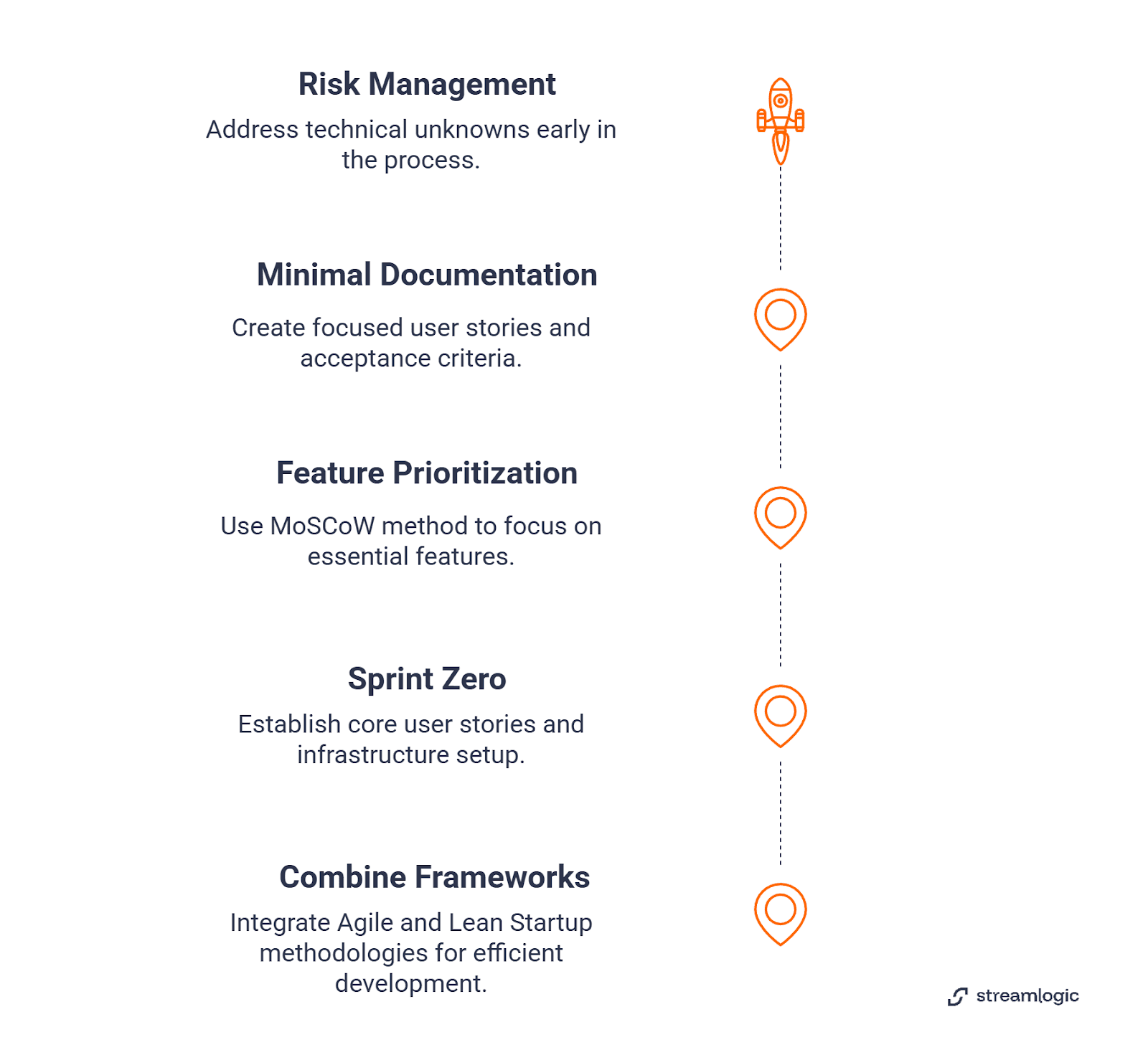
Combine both frameworks. Run 2-week sprints focused on testable hypotheses. Each sprint ships working features you can validate with real users. This rhythm keeps teams focused and prevents scope creep.
Sprint zero sets the foundation. Spend the first week defining core user stories, setting up infrastructure, and creating a deployment pipeline. Skipping this step wastes time on technical decisions during development sprints.
Feature prioritization determines everything. Use the MoSCoW method: Must have, Should have, Could have, Won't have. Most MVPs need only 3-5 must-have features to validate the core hypothesis.
Documentation stays minimal but focused. Write user stories, acceptance criteria, and API contracts. Skip lengthy specs and detailed flowcharts. These artifacts slow teams down and become outdated quickly.
Risk management shifts left. Identify technical unknowns in sprint zero and tackle them first. Delaying hard problems leads to rushed endings, compromised quality, and missed deadlines.
Five strategies to cut development time
Feature prioritization that works
Start with one core hypothesis. Ask: "What single feature validates our riskiest assumption?" Build only that feature first.
The Kano model separates features into basic needs, performance needs, and excitement features. MVPs require basic needs only. Performance and excitement features come after validation.
User story mapping visualizes the entire product journey, then cuts everything except the critical path. This exercise helps founders identify which features are truly essential, often eliminating the majority of initial ideas.
Prioritization matrices fail for MVPs. They waste time scoring features when you should build the minimum to test assumptions. Choose the riskiest assumption and build the smallest feature set to test it.
Sprint planning for MVPs
Two-week sprints balance momentum and flexibility. Shorter sprints create overhead. Longer sprints delay feedback.
Sprint component | Time allocation | Purpose |
Planning | 2-3 hours | Define sprint goals and break down stories |
Daily standups | 15 minutes | Sync progress and remove blockers |
Development | 8-9 days | Write code and run tests |
Review & retrospective | 2,5-3,5 hours | Demo features and improve process |
Based on 2-week sprint standard
Sprint goals stay concrete and testable. Bad goal: "Improve user experience." Good goal: "Users can create an account and complete their profile in under 2 minutes."
Velocity tracking starts after sprint three. Early velocity numbers mislead because teams are still learning the codebase and establishing patterns. Focus on completing stories.
Technical debt gets scheduled time. Allocate 20% of each sprint to refactoring, bug fixes, and infrastructure. Skipping this creates problems for every future sprint.
API integration over custom builds
Third-party APIs eliminate months of development. Payment processing, authentication, email delivery, and file storage all have mature API solutions.
Stripe handles payments in hours instead of months. Auth0 implements authentication in days instead of weeks. SendGrid manages email delivery without building infrastructure. AWS S3 stores files without server management.
API selection criteria matter. Prioritize services with clear documentation, active support communities, and transparent pricing. Check API response times and uptime guarantees before integration.
Cost-benefit analysis for APIs differs from traditional build-vs-buy decisions. For MVPs, APIs almost always win because development time costs more than subscription fees. Build custom solutions only after validation proves the business model.
Integration complexity varies by API maturity. Well-documented REST APIs with clear endpoints integrate quickly. GraphQL APIs require schema familiarity but reduce ongoing maintenance through precise data fetching. Poorly documented APIs can extend integration timelines by weeks as developers work through trial and error.
Platform comparison: low-code and no-code
No-code platforms let non-developers build MVPs through visual interfaces. Bubble, Webflow, and Adalo handle common web and mobile app patterns. These platforms work for content sites, marketplaces, and simple SaaS products.
Low-code platforms bridge the gap between no-code simplicity and custom code flexibility. OutSystems, Mendix, and Microsoft Power Apps support complex business logic while accelerating development. These suit enterprise applications and workflow automation.
The low-code market will grow from $32.8 billion in 2025 to $348.6 billion by 2035, according to Roots Analysis. The rapid application development market expands from $38.83 billion in 2024 to $185.15 billion by 2032, per 360iResearch.
Platform limitations become apparent at scale. No-code platforms restrict custom integrations and complex workflows. Low-code platforms impose vendor lock-in and higher per-user costs. Plan migration paths before committing to these tools.
Custom development gives complete control but requires more time. Choose custom development when the core product differentiator requires proprietary technology. For everything else, platform tools accelerate validation.
Third-party services and pre-built solutions
Pre-built solutions handle common features faster than custom development. Use Stripe for payments, Twilio for communications, Algolia for search, and Cloudinary for media management.
Component libraries accelerate frontend development. Material-UI, Ant Design, and Chakra UI provide production-ready components. These libraries save 40-60 hours per project compared to building UI from scratch.
Backend-as-a-Service platforms eliminate infrastructure setup. Firebase, Supabase, and AWS Amplify provide authentication, databases, and APIs through simple SDKs. Teams launch backends in days instead of weeks.
The tradeoff comes in customization limits. Third-party services work perfectly for standard use cases but struggle with unique requirements. Assess your core differentiators before choosing pre-built solutions.
Integration patterns matter. Use webhooks for real-time updates, batch processing for large data transfers, and polling only as a last resort. Well-designed integrations add 10-15% development time. Poor integrations double project timelines.
Choosing tools for your timeline
Tool selection directly affects delivery speed. The wrong technology stack adds weeks to development. Choose tools based on team expertise, project requirements, and available integrations.
Tool category | Best for speed | Best for scale | Best for flexibility |
Frontend | Next.js + Vercel | React + Custom | Vue.js + Nuxt |
Backend | Firebase | Node.js + Express | Django + PostgreSQL |
Database | Supabase | PostgreSQL | MongoDB |
Hosting | Vercel | AWS | Digital Ocean |
Auth | Auth0 | Custom JWT | Supabase Auth |
Technology familiarity trumps technical superiority for MVPs. A team that knows Django well will ship faster with Django than with a "better" framework they've never used.
Development environment setup consumes the first 2-3 days. Use containerization with Docker to standardize environments across team members. This prevents "works on my machine" problems that waste debugging time.
CI/CD pipelines catch bugs earlier and deploy faster. GitHub Actions, GitLab CI, or CircleCI automate testing and deployment. Teams with automated pipelines deploy 5-10 times more frequently than teams doing manual releases.
Monitoring and error tracking start on day one. Sentry catches errors in production. LogRocket records user sessions. These tools cost less than debugging production issues without visibility.
Seven timeline killers to avoid
Timeline killer | Why it happens | How to prevent |
Scope creep | Stakeholders add features mid-sprint | Lock features after sprint planning; track new requests in backlog for post-MVP evaluation |
Perfect code syndrome | Developers over-engineer solutions | Set explicit "good enough" standards; remind team MVP will be rebuilt after validation |
Unclear requirements | Features lack clear success criteria | Write acceptance criteria for every user story; no story enters sprint without defined done conditions |
Integration delays | Third-party APIs fail late in development | Tackle all integrations in first two sprints; test APIs early |
Technical debt | Deferred cleanup accumulates and slows future work | Allocate 20% of each sprint to refactoring, bug fixes, and infrastructure improvements |
Decision paralysis | Teams spend too long debating options | Set 30-minute decision deadlines; pick one option and move forward; most decisions are reversible |
Communication gaps | Distributed teams lose alignment | Daily standups mandatory; async updates via Slack or Linear; document all technical decisions |
Timeline and budget expectations
MVP development costs typically range from $5,000 to $50,000 depending on complexity. Simple validation products start around $5,000-$20,000, while standard builds range $15,000-$50,000.
Development timelines span 2 weeks to 2 months. No-code MVPs launch in 2-4 weeks, while low-code products require 4-8 weeks. Y Combinator data shows successful startups launch initial MVPs within 8-12 weeks of ideation.
Your numbers will differ based on feature complexity, team composition, and development approach.
Development approach | Timeline | Estimated cost range |
No-code MVP | 2-4 weeks | $5,000-$20,000 |
Low-code MVP | 4-8 weeks | $15,000-$50,000 |
These ranges reflect 2024-2025 market averages.
Budget planning extends beyond initial development. Include hosting, third-party services, support costs, and iteration expenses. For MVP cost estimation, book a session with our CTO Denis Abramenko.
Building feedback into the process
User feedback starts before launch. Show prototypes to 5-10 target users every sprint. Their reactions reveal usability issues and priority mismatches faster than any internal review.
Feedback collection needs structure. Use tools like Hotjar for heatmaps, Intercom for in-app messages, and Typeform for structured surveys. Each tool answers different questions about user behavior.
Analytics implementation happens in sprint one. Google Analytics tracks page views and conversions. Mixpanel measures feature usage and user retention. Amplitude analyzes user paths and drop-off points.
The build-measure-learn cycle compresses learning time. Deploy features quickly, measure user behavior, and learn what works. Teams running weekly cycles outlearn teams running monthly cycles by a factor of four.
Feedback prioritization matters more than collection. Use the ICE framework: Impact, Confidence, Ease. Score each piece of feedback and tackle high-ICE items first.
Product-market fit signals appear in usage data. Look for repeat usage, organic growth, and high retention rates. These metrics matter more than user satisfaction surveys because they measure behavior.
Which development partner fits your project?

MVP development services vary in speed, cost, and expertise. Choose partners based on your timeline, budget, and technical requirements.
Nearshore teams offer time zone alignment and cultural proximity. Eastern European teams provide strong technical skills at competitive rates. Communication happens during overlapping work hours, speeding up decision-making.
Look for teams experienced in your industry vertical. Remote cross-functional teams eliminate handoff delays between design, development, and testing phases. Choose partners who understand your market and users.
Portfolio review reveals execution quality. Examine 3-5 previous MVPs the team built. Check if products launched on schedule, remained in the market, and achieved validation goals.
Technical capabilities should match your needs. Teams strong in mobile development differ from teams excelling at web applications. Software testing services catch issues before user discovery, saving reputation and debugging time.
FAQ
How long does rapid MVP development actually take?
Most MVPs take 6-16 weeks from kickoff to launch depending on complexity. Simple products using no-code platforms launch in 2-4 weeks. Standard builds using low-code tools require 4-8 weeks. Custom development typically needs 8-16 weeks.
Timeline depends on feature count, team availability, and decision-making speed.
What features should a minimal viable product include?
Include only features that test your riskiest assumption. Most MVPs need 3-5 core features maximum. Focus on the minimum functionality that proves users will pay for your solution.
How do you balance speed with code quality?
Set explicit quality standards before development starts. Write automated tests for critical paths. Accept that you'll refactor MVP code after validation. The goal is learning.
When should you choose custom development over no-code platforms?
Choose custom development when your core differentiator requires proprietary technology. Use no-code or low-code platforms for standard features like user management, payments, or content display.
How do you prevent scope creep in rapid development?
Lock features after sprint planning. Track all new feature requests in a backlog. Evaluate new requests only after MVP launch and initial validation.
Conclusion
Rapid MVP development compresses learning cycles and extends the runway. The strategies covered - feature prioritization, sprint planning, API integration, platform selection, and pre-built solutions - cut months from timelines.
Speed serves validation. Launch quickly to test assumptions with real users. Iterate based on data. This approach reveals product-market fit faster and cheaper than traditional development.
Your next MVP can launch in weeks. Book a consultation with Streamlogic's experts to scope your MVP and get timeline estimates.
Denis Avramenko
CTO, Co-Founder, Streamlogic

Technology Articles
Cloud Modernization Strategy Guide for Enterprises 2026
Dec 18, 2025

Technology Articles
How to Develop Cloud Applications: Complete Planning to Deployment Roadmap 2026
Dec 18, 2025

Technology Articles
Cloud Compliance in 2026: Navigating Standards, Strategies, and Best Practices
Dec 12, 2025
Technology Articles
Cloud Modernization Strategy Guide for Enterprises 2026
Dec 18, 2025
Technology Articles
How to Develop Cloud Applications: Complete Planning to Deployment Roadmap 2026
Dec 18, 2025
Technology Articles
Cloud Compliance in 2026: Navigating Standards, Strategies, and Best Practices
Dec 12, 2025
Reading time: 11 minutes
Table of Contents
Speed vs. survival in MVP launches
Frameworks to compress timelines
Five strategies to cut development time
Choosing tools for your timeline
Seven timeline killers to avoid
Timeline and budget expectations
Building feedback into the process
Which development partner fits your project?
Building an MVP faster gives you months of extra runway. Each week saved means earlier revenue, quicker pivots, and lower burn rate before you find product-market fit.
Speed compounds. Launch in 8 weeks instead of 16, and you gain two extra iteration cycles before competitors enter the market. The minimal viable product approach works because it forces focus on features users actually need.
This guide covers frameworks to compress timelines, strategies to cut development time, and tools comparison for rapid MVP launches.
Speed vs. survival in MVP launches
Market timing outweighs perfect execution. A functional MVP in 8 weeks outperforms a polished product in 6 months because you learn faster and adjust sooner.
The Lean Startup methodology proves this. Test assumptions early, gather user feedback, and iterate based on real behavior. Companies using this approach spend less on features nobody wants.
Speed creates strategic advantages beyond time to market. Earlier launches mean earlier revenue, faster learning cycles, and more runway to find product-market fit. Late entries lose positioning and waste resources building features the market already rejected.
Three factors determine MVP velocity: scope discipline, technical decisions, and team structure. Founders who master these ships faster without sacrificing quality.
Frameworks to compress timelines
Agile development and Lean Startup methodology work together to accelerate MVP launches. Agile software development breaks projects into 1-2 week sprints. Lean Startup adds validation through build-measure-learn cycles.
Combine both frameworks. Run 2-week sprints focused on testable hypotheses. Each sprint ships working features you can validate with real users. This rhythm keeps teams focused and prevents scope creep.
Sprint zero sets the foundation. Spend the first week defining core user stories, setting up infrastructure, and creating a deployment pipeline. Skipping this step wastes time on technical decisions during development sprints.
Feature prioritization determines everything. Use the MoSCoW method: Must have, Should have, Could have, Won't have. Most MVPs need only 3-5 must-have features to validate the core hypothesis.
Documentation stays minimal but focused. Write user stories, acceptance criteria, and API contracts. Skip lengthy specs and detailed flowcharts. These artifacts slow teams down and become outdated quickly.
Risk management shifts left. Identify technical unknowns in sprint zero and tackle them first. Delaying hard problems leads to rushed endings, compromised quality, and missed deadlines.
Five strategies to cut development time
Feature prioritization that works
Start with one core hypothesis. Ask: "What single feature validates our riskiest assumption?" Build only that feature first.
The Kano model separates features into basic needs, performance needs, and excitement features. MVPs require basic needs only. Performance and excitement features come after validation.
User story mapping visualizes the entire product journey, then cuts everything except the critical path. This exercise helps founders identify which features are truly essential, often eliminating the majority of initial ideas.
Prioritization matrices fail for MVPs. They waste time scoring features when you should build the minimum to test assumptions. Choose the riskiest assumption and build the smallest feature set to test it.
Sprint planning for MVPs
Two-week sprints balance momentum and flexibility. Shorter sprints create overhead. Longer sprints delay feedback.
Sprint component | Time allocation | Purpose |
Planning | 2-3 hours | Define sprint goals and break down stories |
Daily standups | 15 minutes | Sync progress and remove blockers |
Development | 8-9 days | Write code and run tests |
Review & retrospective | 2,5-3,5 hours | Demo features and improve process |
Based on 2-week sprint standard
Sprint goals stay concrete and testable. Bad goal: "Improve user experience." Good goal: "Users can create an account and complete their profile in under 2 minutes."
Velocity tracking starts after sprint three. Early velocity numbers mislead because teams are still learning the codebase and establishing patterns. Focus on completing stories.
Technical debt gets scheduled time. Allocate 20% of each sprint to refactoring, bug fixes, and infrastructure. Skipping this creates problems for every future sprint.
API integration over custom builds
Third-party APIs eliminate months of development. Payment processing, authentication, email delivery, and file storage all have mature API solutions.
Stripe handles payments in hours instead of months. Auth0 implements authentication in days instead of weeks. SendGrid manages email delivery without building infrastructure. AWS S3 stores files without server management.
API selection criteria matter. Prioritize services with clear documentation, active support communities, and transparent pricing. Check API response times and uptime guarantees before integration.
Cost-benefit analysis for APIs differs from traditional build-vs-buy decisions. For MVPs, APIs almost always win because development time costs more than subscription fees. Build custom solutions only after validation proves the business model.
Integration complexity varies by API maturity. Well-documented REST APIs with clear endpoints integrate quickly. GraphQL APIs require schema familiarity but reduce ongoing maintenance through precise data fetching. Poorly documented APIs can extend integration timelines by weeks as developers work through trial and error.
Platform comparison: low-code and no-code
No-code platforms let non-developers build MVPs through visual interfaces. Bubble, Webflow, and Adalo handle common web and mobile app patterns. These platforms work for content sites, marketplaces, and simple SaaS products.
Low-code platforms bridge the gap between no-code simplicity and custom code flexibility. OutSystems, Mendix, and Microsoft Power Apps support complex business logic while accelerating development. These suit enterprise applications and workflow automation.
The low-code market will grow from $32.8 billion in 2025 to $348.6 billion by 2035, according to Roots Analysis. The rapid application development market expands from $38.83 billion in 2024 to $185.15 billion by 2032, per 360iResearch.
Platform limitations become apparent at scale. No-code platforms restrict custom integrations and complex workflows. Low-code platforms impose vendor lock-in and higher per-user costs. Plan migration paths before committing to these tools.
Custom development gives complete control but requires more time. Choose custom development when the core product differentiator requires proprietary technology. For everything else, platform tools accelerate validation.
Third-party services and pre-built solutions
Pre-built solutions handle common features faster than custom development. Use Stripe for payments, Twilio for communications, Algolia for search, and Cloudinary for media management.
Component libraries accelerate frontend development. Material-UI, Ant Design, and Chakra UI provide production-ready components. These libraries save 40-60 hours per project compared to building UI from scratch.
Backend-as-a-Service platforms eliminate infrastructure setup. Firebase, Supabase, and AWS Amplify provide authentication, databases, and APIs through simple SDKs. Teams launch backends in days instead of weeks.
The tradeoff comes in customization limits. Third-party services work perfectly for standard use cases but struggle with unique requirements. Assess your core differentiators before choosing pre-built solutions.
Integration patterns matter. Use webhooks for real-time updates, batch processing for large data transfers, and polling only as a last resort. Well-designed integrations add 10-15% development time. Poor integrations double project timelines.
Choosing tools for your timeline
Tool selection directly affects delivery speed. The wrong technology stack adds weeks to development. Choose tools based on team expertise, project requirements, and available integrations.
Tool category | Best for speed | Best for scale | Best for flexibility |
Frontend | Next.js + Vercel | React + Custom | Vue.js + Nuxt |
Backend | Firebase | Node.js + Express | Django + PostgreSQL |
Database | Supabase | PostgreSQL | MongoDB |
Hosting | Vercel | AWS | Digital Ocean |
Auth | Auth0 | Custom JWT | Supabase Auth |
Technology familiarity trumps technical superiority for MVPs. A team that knows Django well will ship faster with Django than with a "better" framework they've never used.
Development environment setup consumes the first 2-3 days. Use containerization with Docker to standardize environments across team members. This prevents "works on my machine" problems that waste debugging time.
CI/CD pipelines catch bugs earlier and deploy faster. GitHub Actions, GitLab CI, or CircleCI automate testing and deployment. Teams with automated pipelines deploy 5-10 times more frequently than teams doing manual releases.
Monitoring and error tracking start on day one. Sentry catches errors in production. LogRocket records user sessions. These tools cost less than debugging production issues without visibility.
Seven timeline killers to avoid
Timeline killer | Why it happens | How to prevent |
Scope creep | Stakeholders add features mid-sprint | Lock features after sprint planning; track new requests in backlog for post-MVP evaluation |
Perfect code syndrome | Developers over-engineer solutions | Set explicit "good enough" standards; remind team MVP will be rebuilt after validation |
Unclear requirements | Features lack clear success criteria | Write acceptance criteria for every user story; no story enters sprint without defined done conditions |
Integration delays | Third-party APIs fail late in development | Tackle all integrations in first two sprints; test APIs early |
Technical debt | Deferred cleanup accumulates and slows future work | Allocate 20% of each sprint to refactoring, bug fixes, and infrastructure improvements |
Decision paralysis | Teams spend too long debating options | Set 30-minute decision deadlines; pick one option and move forward; most decisions are reversible |
Communication gaps | Distributed teams lose alignment | Daily standups mandatory; async updates via Slack or Linear; document all technical decisions |
Timeline and budget expectations
MVP development costs typically range from $5,000 to $50,000 depending on complexity. Simple validation products start around $5,000-$20,000, while standard builds range $15,000-$50,000.
Development timelines span 2 weeks to 2 months. No-code MVPs launch in 2-4 weeks, while low-code products require 4-8 weeks. Y Combinator data shows successful startups launch initial MVPs within 8-12 weeks of ideation.
Your numbers will differ based on feature complexity, team composition, and development approach.
Development approach | Timeline | Estimated cost range |
No-code MVP | 2-4 weeks | $5,000-$20,000 |
Low-code MVP | 4-8 weeks | $15,000-$50,000 |
These ranges reflect 2024-2025 market averages.
Budget planning extends beyond initial development. Include hosting, third-party services, support costs, and iteration expenses. For MVP cost estimation, book a session with our CTO Denis Abramenko.
Building feedback into the process
User feedback starts before launch. Show prototypes to 5-10 target users every sprint. Their reactions reveal usability issues and priority mismatches faster than any internal review.
Feedback collection needs structure. Use tools like Hotjar for heatmaps, Intercom for in-app messages, and Typeform for structured surveys. Each tool answers different questions about user behavior.
Analytics implementation happens in sprint one. Google Analytics tracks page views and conversions. Mixpanel measures feature usage and user retention. Amplitude analyzes user paths and drop-off points.
The build-measure-learn cycle compresses learning time. Deploy features quickly, measure user behavior, and learn what works. Teams running weekly cycles outlearn teams running monthly cycles by a factor of four.
Feedback prioritization matters more than collection. Use the ICE framework: Impact, Confidence, Ease. Score each piece of feedback and tackle high-ICE items first.
Product-market fit signals appear in usage data. Look for repeat usage, organic growth, and high retention rates. These metrics matter more than user satisfaction surveys because they measure behavior.
Which development partner fits your project?
MVP development services vary in speed, cost, and expertise. Choose partners based on your timeline, budget, and technical requirements.
Nearshore teams offer time zone alignment and cultural proximity. Eastern European teams provide strong technical skills at competitive rates. Communication happens during overlapping work hours, speeding up decision-making.
Look for teams experienced in your industry vertical. Remote cross-functional teams eliminate handoff delays between design, development, and testing phases. Choose partners who understand your market and users.
Portfolio review reveals execution quality. Examine 3-5 previous MVPs the team built. Check if products launched on schedule, remained in the market, and achieved validation goals.
Technical capabilities should match your needs. Teams strong in mobile development differ from teams excelling at web applications. Software testing services catch issues before user discovery, saving reputation and debugging time.
FAQ
How long does rapid MVP development actually take?
Most MVPs take 6-16 weeks from kickoff to launch depending on complexity. Simple products using no-code platforms launch in 2-4 weeks. Standard builds using low-code tools require 4-8 weeks. Custom development typically needs 8-16 weeks.
Timeline depends on feature count, team availability, and decision-making speed.
What features should a minimal viable product include?
Include only features that test your riskiest assumption. Most MVPs need 3-5 core features maximum. Focus on the minimum functionality that proves users will pay for your solution.
How do you balance speed with code quality?
Set explicit quality standards before development starts. Write automated tests for critical paths. Accept that you'll refactor MVP code after validation. The goal is learning.
When should you choose custom development over no-code platforms?
Choose custom development when your core differentiator requires proprietary technology. Use no-code or low-code platforms for standard features like user management, payments, or content display.
How do you prevent scope creep in rapid development?
Lock features after sprint planning. Track all new feature requests in a backlog. Evaluate new requests only after MVP launch and initial validation.
Conclusion
Rapid MVP development compresses learning cycles and extends the runway. The strategies covered - feature prioritization, sprint planning, API integration, platform selection, and pre-built solutions - cut months from timelines.
Speed serves validation. Launch quickly to test assumptions with real users. Iterate based on data. This approach reveals product-market fit faster and cheaper than traditional development.
Your next MVP can launch in weeks. Book a consultation with Streamlogic's experts to scope your MVP and get timeline estimates.
Denis Avramenko
CTO, Co-Founder, Streamlogic
Reading time: 11 minutes
Table of Contents
Speed vs. survival in MVP launches
Frameworks to compress timelines
Five strategies to cut development time
Choosing tools for your timeline
Seven timeline killers to avoid
Timeline and budget expectations
Building feedback into the process
Which development partner fits your project?
Building an MVP faster gives you months of extra runway. Each week saved means earlier revenue, quicker pivots, and lower burn rate before you find product-market fit.
Speed compounds. Launch in 8 weeks instead of 16, and you gain two extra iteration cycles before competitors enter the market. The minimal viable product approach works because it forces focus on features users actually need.
This guide covers frameworks to compress timelines, strategies to cut development time, and tools comparison for rapid MVP launches.
Speed vs. survival in MVP launches
Market timing outweighs perfect execution. A functional MVP in 8 weeks outperforms a polished product in 6 months because you learn faster and adjust sooner.
The Lean Startup methodology proves this. Test assumptions early, gather user feedback, and iterate based on real behavior. Companies using this approach spend less on features nobody wants.
Speed creates strategic advantages beyond time to market. Earlier launches mean earlier revenue, faster learning cycles, and more runway to find product-market fit. Late entries lose positioning and waste resources building features the market already rejected.
Three factors determine MVP velocity: scope discipline, technical decisions, and team structure. Founders who master these ships faster without sacrificing quality.
Frameworks to compress timelines
Agile development and Lean Startup methodology work together to accelerate MVP launches. Agile software development breaks projects into 1-2 week sprints. Lean Startup adds validation through build-measure-learn cycles.
Combine both frameworks. Run 2-week sprints focused on testable hypotheses. Each sprint ships working features you can validate with real users. This rhythm keeps teams focused and prevents scope creep.
Sprint zero sets the foundation. Spend the first week defining core user stories, setting up infrastructure, and creating a deployment pipeline. Skipping this step wastes time on technical decisions during development sprints.
Feature prioritization determines everything. Use the MoSCoW method: Must have, Should have, Could have, Won't have. Most MVPs need only 3-5 must-have features to validate the core hypothesis.
Documentation stays minimal but focused. Write user stories, acceptance criteria, and API contracts. Skip lengthy specs and detailed flowcharts. These artifacts slow teams down and become outdated quickly.
Risk management shifts left. Identify technical unknowns in sprint zero and tackle them first. Delaying hard problems leads to rushed endings, compromised quality, and missed deadlines.
Five strategies to cut development time
Feature prioritization that works
Start with one core hypothesis. Ask: "What single feature validates our riskiest assumption?" Build only that feature first.
The Kano model separates features into basic needs, performance needs, and excitement features. MVPs require basic needs only. Performance and excitement features come after validation.
User story mapping visualizes the entire product journey, then cuts everything except the critical path. This exercise helps founders identify which features are truly essential, often eliminating the majority of initial ideas.
Prioritization matrices fail for MVPs. They waste time scoring features when you should build the minimum to test assumptions. Choose the riskiest assumption and build the smallest feature set to test it.
Sprint planning for MVPs
Two-week sprints balance momentum and flexibility. Shorter sprints create overhead. Longer sprints delay feedback.
Sprint component | Time allocation | Purpose |
Planning | 2-3 hours | Define sprint goals and break down stories |
Daily standups | 15 minutes | Sync progress and remove blockers |
Development | 8-9 days | Write code and run tests |
Review & retrospective | 2,5-3,5 hours | Demo features and improve process |
Based on 2-week sprint standard
Sprint goals stay concrete and testable. Bad goal: "Improve user experience." Good goal: "Users can create an account and complete their profile in under 2 minutes."
Velocity tracking starts after sprint three. Early velocity numbers mislead because teams are still learning the codebase and establishing patterns. Focus on completing stories.
Technical debt gets scheduled time. Allocate 20% of each sprint to refactoring, bug fixes, and infrastructure. Skipping this creates problems for every future sprint.
API integration over custom builds
Third-party APIs eliminate months of development. Payment processing, authentication, email delivery, and file storage all have mature API solutions.
Stripe handles payments in hours instead of months. Auth0 implements authentication in days instead of weeks. SendGrid manages email delivery without building infrastructure. AWS S3 stores files without server management.
API selection criteria matter. Prioritize services with clear documentation, active support communities, and transparent pricing. Check API response times and uptime guarantees before integration.
Cost-benefit analysis for APIs differs from traditional build-vs-buy decisions. For MVPs, APIs almost always win because development time costs more than subscription fees. Build custom solutions only after validation proves the business model.
Integration complexity varies by API maturity. Well-documented REST APIs with clear endpoints integrate quickly. GraphQL APIs require schema familiarity but reduce ongoing maintenance through precise data fetching. Poorly documented APIs can extend integration timelines by weeks as developers work through trial and error.
Platform comparison: low-code and no-code
No-code platforms let non-developers build MVPs through visual interfaces. Bubble, Webflow, and Adalo handle common web and mobile app patterns. These platforms work for content sites, marketplaces, and simple SaaS products.
Low-code platforms bridge the gap between no-code simplicity and custom code flexibility. OutSystems, Mendix, and Microsoft Power Apps support complex business logic while accelerating development. These suit enterprise applications and workflow automation.
The low-code market will grow from $32.8 billion in 2025 to $348.6 billion by 2035, according to Roots Analysis. The rapid application development market expands from $38.83 billion in 2024 to $185.15 billion by 2032, per 360iResearch.
Platform limitations become apparent at scale. No-code platforms restrict custom integrations and complex workflows. Low-code platforms impose vendor lock-in and higher per-user costs. Plan migration paths before committing to these tools.
Custom development gives complete control but requires more time. Choose custom development when the core product differentiator requires proprietary technology. For everything else, platform tools accelerate validation.
Third-party services and pre-built solutions
Pre-built solutions handle common features faster than custom development. Use Stripe for payments, Twilio for communications, Algolia for search, and Cloudinary for media management.
Component libraries accelerate frontend development. Material-UI, Ant Design, and Chakra UI provide production-ready components. These libraries save 40-60 hours per project compared to building UI from scratch.
Backend-as-a-Service platforms eliminate infrastructure setup. Firebase, Supabase, and AWS Amplify provide authentication, databases, and APIs through simple SDKs. Teams launch backends in days instead of weeks.
The tradeoff comes in customization limits. Third-party services work perfectly for standard use cases but struggle with unique requirements. Assess your core differentiators before choosing pre-built solutions.
Integration patterns matter. Use webhooks for real-time updates, batch processing for large data transfers, and polling only as a last resort. Well-designed integrations add 10-15% development time. Poor integrations double project timelines.
Choosing tools for your timeline
Tool selection directly affects delivery speed. The wrong technology stack adds weeks to development. Choose tools based on team expertise, project requirements, and available integrations.
Tool category | Best for speed | Best for scale | Best for flexibility |
Frontend | Next.js + Vercel | React + Custom | Vue.js + Nuxt |
Backend | Firebase | Node.js + Express | Django + PostgreSQL |
Database | Supabase | PostgreSQL | MongoDB |
Hosting | Vercel | AWS | Digital Ocean |
Auth | Auth0 | Custom JWT | Supabase Auth |
Technology familiarity trumps technical superiority for MVPs. A team that knows Django well will ship faster with Django than with a "better" framework they've never used.
Development environment setup consumes the first 2-3 days. Use containerization with Docker to standardize environments across team members. This prevents "works on my machine" problems that waste debugging time.
CI/CD pipelines catch bugs earlier and deploy faster. GitHub Actions, GitLab CI, or CircleCI automate testing and deployment. Teams with automated pipelines deploy 5-10 times more frequently than teams doing manual releases.
Monitoring and error tracking start on day one. Sentry catches errors in production. LogRocket records user sessions. These tools cost less than debugging production issues without visibility.
Seven timeline killers to avoid
Timeline killer | Why it happens | How to prevent |
Scope creep | Stakeholders add features mid-sprint | Lock features after sprint planning; track new requests in backlog for post-MVP evaluation |
Perfect code syndrome | Developers over-engineer solutions | Set explicit "good enough" standards; remind team MVP will be rebuilt after validation |
Unclear requirements | Features lack clear success criteria | Write acceptance criteria for every user story; no story enters sprint without defined done conditions |
Integration delays | Third-party APIs fail late in development | Tackle all integrations in first two sprints; test APIs early |
Technical debt | Deferred cleanup accumulates and slows future work | Allocate 20% of each sprint to refactoring, bug fixes, and infrastructure improvements |
Decision paralysis | Teams spend too long debating options | Set 30-minute decision deadlines; pick one option and move forward; most decisions are reversible |
Communication gaps | Distributed teams lose alignment | Daily standups mandatory; async updates via Slack or Linear; document all technical decisions |
Timeline and budget expectations
MVP development costs typically range from $5,000 to $50,000 depending on complexity. Simple validation products start around $5,000-$20,000, while standard builds range $15,000-$50,000.
Development timelines span 2 weeks to 2 months. No-code MVPs launch in 2-4 weeks, while low-code products require 4-8 weeks. Y Combinator data shows successful startups launch initial MVPs within 8-12 weeks of ideation.
Your numbers will differ based on feature complexity, team composition, and development approach.
Development approach | Timeline | Estimated cost range |
No-code MVP | 2-4 weeks | $5,000-$20,000 |
Low-code MVP | 4-8 weeks | $15,000-$50,000 |
These ranges reflect 2024-2025 market averages.
Budget planning extends beyond initial development. Include hosting, third-party services, support costs, and iteration expenses. For MVP cost estimation, book a session with our CTO Denis Abramenko.
Building feedback into the process
User feedback starts before launch. Show prototypes to 5-10 target users every sprint. Their reactions reveal usability issues and priority mismatches faster than any internal review.
Feedback collection needs structure. Use tools like Hotjar for heatmaps, Intercom for in-app messages, and Typeform for structured surveys. Each tool answers different questions about user behavior.
Analytics implementation happens in sprint one. Google Analytics tracks page views and conversions. Mixpanel measures feature usage and user retention. Amplitude analyzes user paths and drop-off points.
The build-measure-learn cycle compresses learning time. Deploy features quickly, measure user behavior, and learn what works. Teams running weekly cycles outlearn teams running monthly cycles by a factor of four.
Feedback prioritization matters more than collection. Use the ICE framework: Impact, Confidence, Ease. Score each piece of feedback and tackle high-ICE items first.
Product-market fit signals appear in usage data. Look for repeat usage, organic growth, and high retention rates. These metrics matter more than user satisfaction surveys because they measure behavior.
Which development partner fits your project?
MVP development services vary in speed, cost, and expertise. Choose partners based on your timeline, budget, and technical requirements.
Nearshore teams offer time zone alignment and cultural proximity. Eastern European teams provide strong technical skills at competitive rates. Communication happens during overlapping work hours, speeding up decision-making.
Look for teams experienced in your industry vertical. Remote cross-functional teams eliminate handoff delays between design, development, and testing phases. Choose partners who understand your market and users.
Portfolio review reveals execution quality. Examine 3-5 previous MVPs the team built. Check if products launched on schedule, remained in the market, and achieved validation goals.
Technical capabilities should match your needs. Teams strong in mobile development differ from teams excelling at web applications. Software testing services catch issues before user discovery, saving reputation and debugging time.
FAQ
How long does rapid MVP development actually take?
Most MVPs take 6-16 weeks from kickoff to launch depending on complexity. Simple products using no-code platforms launch in 2-4 weeks. Standard builds using low-code tools require 4-8 weeks. Custom development typically needs 8-16 weeks.
Timeline depends on feature count, team availability, and decision-making speed.
What features should a minimal viable product include?
Include only features that test your riskiest assumption. Most MVPs need 3-5 core features maximum. Focus on the minimum functionality that proves users will pay for your solution.
How do you balance speed with code quality?
Set explicit quality standards before development starts. Write automated tests for critical paths. Accept that you'll refactor MVP code after validation. The goal is learning.
When should you choose custom development over no-code platforms?
Choose custom development when your core differentiator requires proprietary technology. Use no-code or low-code platforms for standard features like user management, payments, or content display.
How do you prevent scope creep in rapid development?
Lock features after sprint planning. Track all new feature requests in a backlog. Evaluate new requests only after MVP launch and initial validation.
Conclusion
Rapid MVP development compresses learning cycles and extends the runway. The strategies covered - feature prioritization, sprint planning, API integration, platform selection, and pre-built solutions - cut months from timelines.
Speed serves validation. Launch quickly to test assumptions with real users. Iterate based on data. This approach reveals product-market fit faster and cheaper than traditional development.
Your next MVP can launch in weeks. Book a consultation with Streamlogic's experts to scope your MVP and get timeline estimates.
Denis Avramenko
CTO, Co-Founder, Streamlogic
Technology Articles
Cloud Modernization Strategy Guide for Enterprises 2026
Dec 18, 2025
Technology Articles
How to Develop Cloud Applications: Complete Planning to Deployment Roadmap 2026
Dec 18, 2025
Technology Articles
Cloud Compliance in 2026: Navigating Standards, Strategies, and Best Practices
Dec 12, 2025
Tech Council
Technology Articles
Rapid MVP Development: Tools, Strategies, and Timelines for 2026
Learn proven strategies for MVP development: feature prioritization, sprint planning, API integration, and platform selection. Includes timeline estimates, cost ranges, and common mistakes to avoid.
Denis Avramenko
CTO, Co-Founder, Streamlogic
Dec 3, 2025